






Beyond the bot: Why intelligent automation is a boardroom imperative in 2026
A few years ago, Robotic Process Automation (RPA) was the crown jewel of operational efficiency. We deployed software bots to mimic human keystrokes, copy-paste data, and clear out basic back-office backlogs. It worked well, until the underlying data format changed, or a process required an actual decision.
Enter 2026.
The baseline has fundamentally shifted. Standalone, rigid bots are no longer enough to maintain a competitive edge. Today, the mandate is Intelligent Automation (IA). The convergence of AI, machine learning, and process orchestration.
If your organization is still treating automation as an isolated IT project rather than a core strategic lever, here’s why 2026 is the year to rewrite the playbook.
The death of solo bots and the rise of agentic AI
For years, automation was linear. If X happens, do Y.
This was excellent for predictable data entry, but completely fell apart when faced with unstructured data like an unformatted vendor invoice or an ambiguous customer complaint email. In 2026, we are witnessing a massive transition toward Agentic AI and multi-agent systems.
Instead of executing isolated tasks, intelligent agents are given an ultimate business objective. They analyze the problem, choose the necessary tools, evaluate their own work, and collaborate with other specialized AI agents to complete complex, end-to-end workflows. According to Gartner, while only about 17% of organizations had deployed agentic AI by the start of 2026, over 60% expect to deploy it within the next two years, marking one of the most aggressive adoption curves in enterprise history.
Moving from task isolation to hyperautomation
Isolated efficiency gains from automated tasks are deceptive. If you automate a single document-generation step by 80%, but it still sits in a manager’s email inbox for four days waiting for a signature, your cycle time hasn’t actually improved. The focus this year is entirely on Hyperautomation—the systematic orchestration of entire, end-to-end business streams.
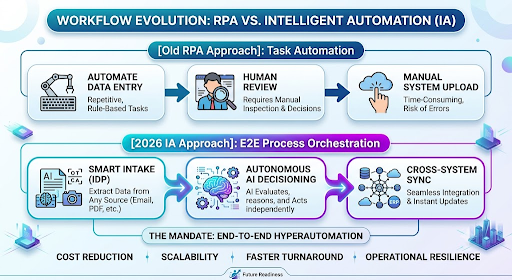
The financial impact of this shift is stark. Data reveals that organizations pairing process redesign with hyperautomation are reducing operational costs by an average of 30% while yielding overall productivity boosts between 26% and 55%.
The 2026 stats driving the boardroom agenda
The modern macroeconomic landscape demands radical efficiency. The numbers backing the Intelligent Automation movement show that it has transitioned from a future-looking line item to an immediate operational baseline.
- Strategic priority: Approximately 90% of large enterprises have officially listed hyperautomation as a core strategic priority.
- Network & IT autonomy: By the end of 2026, 30% of enterprises will have automated over half of their network and IT infrastructure activities.
- Market scale: The global hyperautomation footprint has surged to $68.2 billion in 2026, on a trajectory to eclipse $278 billion by 2035.
Solving the “Patchwork Stack” dilemma
Over the past 36 months, many enterprises have fallen into the trap of buying disjointed AI tools and niche automation applications. The result? Subscription fatigue, massive data silos, and a fragile, fragmented architecture.
A primary focus for executives in 2026 is tech stack consolidation.
Intelligent automation acts as the cohesive tissue over your legacy infrastructure. By utilizing advanced orchestration protocols like the emerging Model Context Protocol (which allows AI to connect across multiple enterprise applications seamlessly), you can unlock data trapped in legacy ERPs and CRMs without undergoing a risky, multi-million dollar core system replacement.
The CXO Reality Check: Intelligent automation is no longer about replacing human workers. It is about scaling your existing workforce’s capability. By automating cognitive busywork, you shift human capital toward strategic growth, market analysis, and high-value customer interactions.
Charting Your Path Forward
Organizations that will dominate the back half of this decade are not waiting around to see how AI settles. They are actively embedding intelligence into their operations today.
The execution strategy doesn’t require boiling the ocean. The most successful rollouts start by targeting two or three high-impact, high-friction workflows (such as complex supply chain tracking, automated compliance reporting, or intelligent invoice reconciliation), proving immediate ROI, and then scaling systematically.
At ESSPL, we specialize in helping enterprise leaders bridge the gap between legacy operations and intelligent, autonomous workflows. Let’s turn your operational bottlenecks into clear competitive advantages.
Schedule a Strategic Advisory Session with our Enterprise Automation Experts.