






From cost center to competitive edge: How RPA implementation radically cuts OPEX
Every organisation has a hidden operating cost.
It lives in the hundreds of repetitive tasks employees perform every day: copying information between systems, reconciling spreadsheets, processing invoices, updating records, generating reports, validating transactions, and chasing exceptions. Individually, these activities may look inexpensive. But at the enterprise scale, they add up to thousands of employee hours, higher processing costs, avoidable errors, and operational bottlenecks.
For CXOs facing persistent pressure to improve margins while maintaining service levels, simply asking teams to “do more with less” has obvious limits. The more sustainable question is: How much of the work are people doing that technology could perform instead?
…and this is where Robotic Process Automation (RPA) can directly influence operating expenditure (OPEX).
Far beyond being a mere “buzzword,” RPA has matured into one of the fastest, most measurable levers for operational cost reduction. When executed with a strategic framework, software bots don’t just shave off marginal expenses. Instead, they fundamentally alter the cost curve of enterprise workflows.
The hard numbers: What the market tells us
If you are evaluating RPA for your enterprise board deck, the business case is backed by compelling data:
- Direct Cost Reductions: According to research by McKinsey, organizations deploying automation can reduce operational costs by 20% to 30% across targeted workflows.
- Rapid Payback Period: Deloitte’s Global Automation Survey reveals that enterprise RPA implementations achieve payback in less than 12 months, while returning up to 20% of full-time equivalent (FTE) capacity back to the business.
- Lowering Compliance Costs: Automating rule-based governance and reporting workflows slashes compliance processing expenses by up to 30% while slashing human error rates by over 90%.
4 core ways RPA implementation directly slashes OPEX
How do these stats translate to your balance sheet? The direct and indirect operational savings fall into four distinct operational buckets:
Eliminating the “rework tax” (Quality & error reduction)
Transposed digits in SAP, delayed invoice matching in ERPs, or miskeyed supply chain manifests result in penalties, delayed collections, and hundreds of wasted hours spent fixing mistakes.
Human error is an invisible drain on OPEX.
RPA bots operate with 100% rule-based consistency. By driving processing error rates down to near zero, you eliminate the costly “rework tax” and prevent revenue leakage before it touches your bottom line.
Maximizing output without increasing headcount
Traditionally, scaling operations meant a linear increase in overhead, as in more FTEs, additional software seats, expanded management structures, and physical equipment.
With RPA, capacity scales exponentially while fixed costs stay flat. A digital workforce handles sudden volume spikes such as end-of-quarter financial reconciliations or seasonal supply chain surges without requiring overtime pay, temp hiring, or bloated administrative budgets.
Unlocking legacy systems without overhauling IT infrastructure
One of the largest enterprise IT expenses is the costly, multi-year legacy modernization project. Rip-and-replace software transitions end up bleeding the OPEX for years.
Because RPA works at the user interface (UI) level, software bots interact with your legacy green-screen apps, homegrown systems, and modern ERPs just like a human worker would, only without the complex, expensive API overhauls. You extend the life and value of existing enterprise infrastructure while cutting manual manual-entry costs today.
Shifting high-cost talent to strategic value
When skilled finance managers spend 15 hours a week manually copy-pasting data across spreadsheets, you are paying high-tier operational salaries for zero-margin tasks. RPA liberates your talent to focus on high-impact initiatives like vendor negotiations, strategic forecasting, and client relationships—improving retention and drastically lowering cost-per-output.
Quick leadership check: Is your business automation-ready?
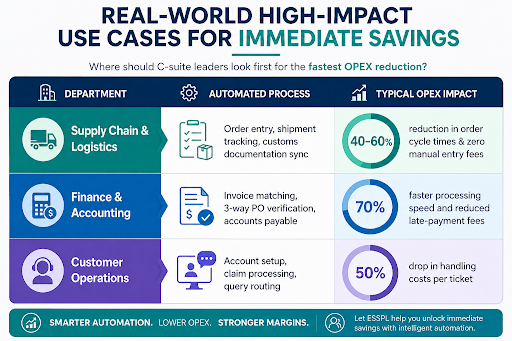
Identify manual, repetitive, rule-based workflows in your supply chain, finance, or customer service departments. If a process requires structured data and consistent rules, it can likely be automated in weeks.
Schedule an automation opportunity assessment with ESSPL.
Avoiding the “pilot trap”: How ESSPL drives enterprise-grade ROI
While the benefits of RPA are undeniable, over 40% of automation initiatives stagnate at the “proof of concept” phase due to lack of governance, poor vendor selection, or unclear process mapping.
At ESSPL, we bring over two decades of deep domain expertise in Digital Supply Chain, Enterprise Integration, and Custom Automation. We don’t just deploy bots; we help CXOs build a scalable Center of Excellence (CoE) that turns fragmented automation into an enterprise engine for cost leadership.
Our methodology ensures:
- Rapid time-to-value: Identifying short-term wins that pay for the implementation inside 6 to 9 months.
- Seamless scalability: Integrating RPA with AI/ML (Hyperautomation) for complex operational needs.
- Enterprise security & governance: Maintaining full auditability and compliance across every bot interaction.
Ready to turn operational costs into strategic savings?
Cutting OPEX doesn’t have to mean shrinking your ambitions. By deploying Intelligent Process Automation, enterprise leaders are delivering bottom-line results, speeding up execution, and giving their workforce the tools to focus on real growth.
Don’t leave your operational efficiency to chance. Talk to an ESSPL automation expert today.