





How to choose the right EDI & B2B integration solution in 2026
For years, choosing an EDI solution was largely a technology decision: Which formats does it support? Can it connect to our ERP? How much does it cost per transaction?
In 2026, this conversation looks very different.
Today, B2B integration is no longer just about passing flat files between trading partners; it is the central nervous system of your business. Enterprises are dealing with increasingly complex partner ecosystems, multiple ERPs, cloud applications, APIs, marketplaces, legacy systems, warehouses, logistics providers and AI-driven workflows. The average organization now manages 957 applications, yet only 27% of them are connected, according to MuleSoft’s 2026 Connectivity Benchmark Report. IT teams also spend an average of 36% of their time designing, building and testing custom integrations. And, if this wasn’t enough, IT leaders are also facing rising demands for real-time data visibility, stricter security protocols, and seamless integration with modern cloud platforms.
So, if your enterprise’s supply chain operations feel more like a fragile house of cards than a synchronized machine, you aren’t alone.
As we step deeper into the era of “EDI 2.0,” picking the right B2B integration solution is a make-or-break strategic decision – and here’s how CXOs and IT leaders can cut through the noise and choose a platform built for the future.
Start with the business problem, not the technology
It is easy for an EDI selection exercise to turn into a long feature comparison.
X12 support? Check.
EDIFACT? Check.
AS2? Check.
APIs? Check.
But a checklist alone rarely tells you whether a solution will actually improve business performance. Start instead with the outcomes you need. This matters because EDI integration affects processes and workflows far beyond document transmission.
IBM notes that integrating EDI with enterprise applications can eliminate manual re-keying, enable 24/7 processing, and accelerate order fulfillment, shipping and payment cycles. It can also improve visibility and reduce the costs associated with data-entry errors and document handling. The strongest business case, therefore, begins with measurable operational KPIs and not simply a technology refresh.
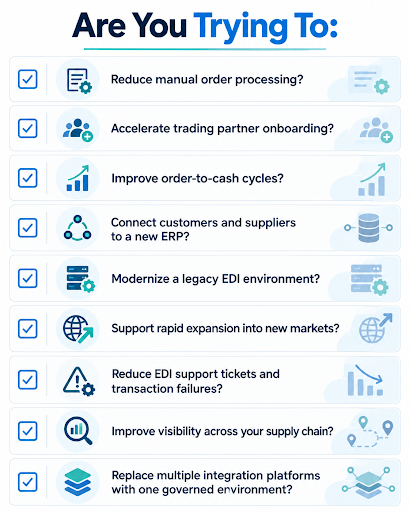
CXO question to ask: Which business metric will improve if we implement this platform successfully?
Look for EDI + API capabilities, not EDI versus API
Treating EDI and APIs as an either/or decision is a rookie mistake in 2026. They solve different problems.
EDI remains highly effective for standardized, repeatable B2B transactions such as purchase orders, invoices, advance shipping notices, and logistics documents. On the other hand, APIs are better suited to scenarios requiring immediate interaction. Think inventory checks, shipment status queries, pricing requests, or real-time digital experiences.
Enterprises need both in 2026. Period.
EDI and APIs are complementary technologies: organizations can combine EDI’s standardization and reliability with the flexibility and responsiveness of APIs (IBM). A future-ready integration solution should, therefore, support a hybrid environment including technologies such as ANSI X12, EDIFACT, XML and JSON, AS2, SFTP/FTPS, REST and SOAP APIs, Webhooks, cloud applications, and ERP and supply chain platforms.
Treat trading partner onboarding as a board-level metric
A new customer signs a contract.
Commercially, the relationship has started. Operationally, nothing happens until the systems can communicate.
Do you see why trading partner onboarding can quickly become a hidden constraint on growth?
Every partner can introduce different document formats, communication protocols, mapping requirements, validation rules and business processes. Even organizations using the same EDI standard may implement fields and requirements differently. This variation is one of the reasons EDI implementation and onboarding can become complex.
When evaluating platforms and providers, ask how quickly they can move a new partner from request to production. Look for capabilities such as reusable maps and templates, automated validation, testing environments, configurable partner profiles and repeatable onboarding workflows. The difference between onboarding a strategic customer in days versus several weeks is not simply an IT productivity improvement. It can affect time-to-revenue.
Don’t let trading partner onboarding slow down your business. Ask ESSPL experts to assess your existing B2B environment, identify onboarding bottlenecks, and build a roadmap for a more scalable EDI and B2B integration model.
Demand end-to-end transaction visibility
In complex B2B environments, visibility becomes just as important as connectivity. A failed EDI message should not require five people and three systems to determine what happened.
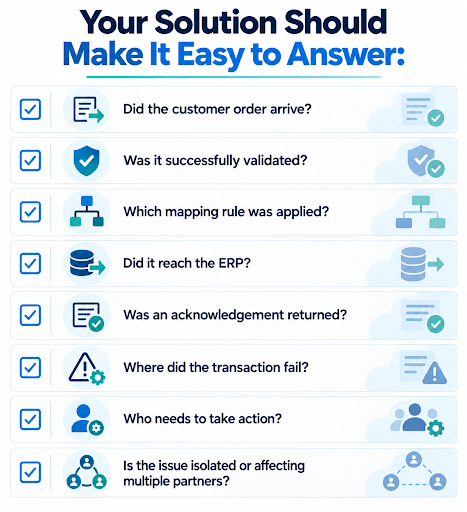
Traditional EDI environments often become reactive. Users discover a problem only after a customer calls, an invoice fails or a shipment gets delayed. Modern integration environments should provide dashboards, transaction tracing, alerts, exception management and searchable logs.
In 2026, increasingly mature platforms are also applying AI and automation to monitoring, anomaly detection and issue resolution.
The objective is straightforward: Move from “something failed” to “we know what failed, why it failed and what happens next.”
Put security and governance into the buying decision
B2B integration platforms sit at a sensitive intersection. They connect internal enterprise systems to customers, suppliers, carriers, logistics providers and other third parties.
Security, therefore, cannot be treated as an infrastructure detail buried near the end of an RFP. Evaluate areas such as data encryption in transit and at rest, identity and access management, role-based permissions, certificates and key management, audit trails, API security, etc.
Governance also becomes more important as APIs proliferate. The 2026 Connectivity Benchmark found that 27% of APIs within organizations remain ungoverned, highlighting the risks created when connectivity grows faster than governance. Ask vendors not only how they connect systems, but how those connections will be monitored, secured and governed over time.
Evaluate integration with your core enterprise systems
The lesson for decision-makers here is simple: Do not buy another integration island.
EDI becomes considerably more valuable when information flows beyond the integration layer. Imagine, for instance, receiving a purchase order electronically but requiring an employee to manually enter it into the ERP. Technically, you have EDI. Operationally, you still have a manual process.
A strong B2B integration architecture should connect transaction flows directly to the systems that run your business, including ERP, WMS, TMS, CRM, order management systems, eCommerce platforms, data platforms, cloud applications, and legacy and mainframe environments.
Assess automation and AI but prioritize useful AI
AI is quickly entering integration platforms but that does not mean “AI-powered” should automatically move a product to the top of your shortlist.Focus on where intelligence can genuinely reduce work.
This becomes increasingly important as integration complexity expands. MuleSoft reports that 82% of IT leaders consider data integration one of their biggest challenges when using AI**, while 86% agree that poorly integrated environments can make AI agents add complexity instead of value.
In other words, AI cannot compensate for weak integration architecture. The foundation comes first.
Finally, evaluate the implementation and managed services partner too
Technology is only one half of a successful EDI transformation. Trading partner knowledge, mapping expertise, implementation discipline, testing, migration experience and production support matter just as much. A strong integration partner should understand both the technology and the business processes behind the transactions.
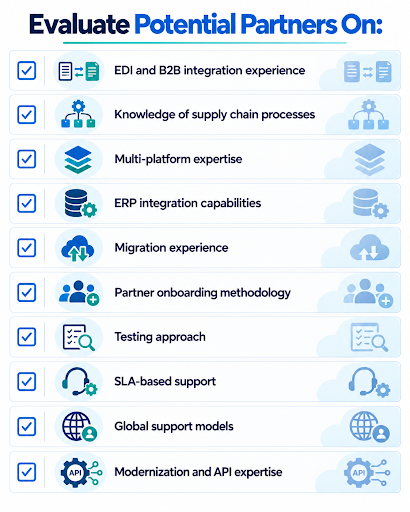
This becomes especially important for organizations migrating large legacy environments, where hundreds (or even thousands) of maps and partner configurations may need to move without disrupting business transactions.
A practical 2026 EDI & B2B integration checklist
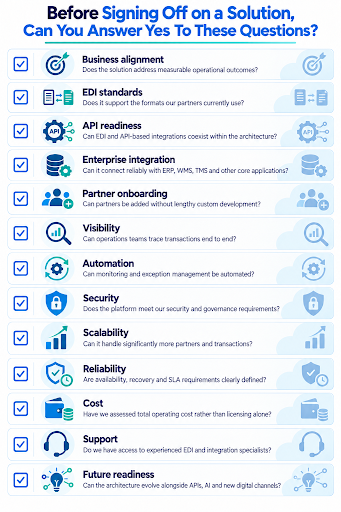
ESSPL’s EDI experts have delivered 2,000+ EDI maps across 500+ trading partners while processing 7.5 million messages per month, alongside EDI consulting, partner setup, mapping, integration and managed support capabilities. Talk to us about building a roadmap that covers your current architecture, trading partner ecosystem, integration requirements and future API strategy, and not just the next platform implementation.