




EDI modernization: How to move from legacy EDI to cloud & API-based integration
For decades, traditional Electronic Data Interchange (EDI) has powered global commerce for decades, and it remains indispensable. Purchase orders reach suppliers. Advance shipping notices reach warehouses. Invoices flow into ERP systems. Logistics partners exchange shipment updates. Millions of transactions happen without someone manually entering the same information twice.
The problem is not that EDI stopped working. It’s just that the business around it changed.
Imagine navigating a high-speed logistics network or an omnichannel retail surge while running your core B2B communications on systems designed during the disco era.
That is the reality for many enterprise leaders today.
Customers now expect real-time information. Supply chains span more partners, platforms, marketplaces, and geographies. Enterprises are moving applications to the cloud. APIs have become central to digital ecosystems. And business leaders increasingly expect integration infrastructure to do more than simply transfer files. They want visibility, scalability, automation, intelligence, and speed.
…and yet, many organizations are still running critical B2B processes through EDI environments designed years, sometimes decades, ago.
This creates an interesting challenge for CIOs, CTOs, COOs, and supply chain leaders:
How do you modernize EDI without disrupting the transactions your business depends on every day?
The answer here is not ripping out EDI altogether, but to modernize the architecture around it.
EDI is not disappearing. It is evolving.
The rise of APIs led to plenty of predictions that EDI would eventually become obsolete. EDI still remains vital for high-volume, mission-critical B2B transactions across industries including retail, manufacturing, logistics, healthcare, energy, e-commerce, and government.
However, keeping a legacy EDI environment unchanged has its own costs.
Older architectures can create:
- Lengthy trading-partner onboarding
- Heavy dependence on custom maps and scripts
- Limited transaction visibility
- High infrastructure and maintenance costs
- Manual exception handling
- Difficulty integrating cloud applications
- Limited real-time data availability
- Dependence on scarce legacy skills
- Slow response to changing customer requirements
Meanwhile, the broader enterprise technology landscape has moved rapidly toward cloud and API-based models. The 2025 Flexera State of the Cloud Report found that more than half of enterprise and SMB workloads were already running in public clouds, while organizations expected cloud spending to increase further.
The message for leadership teams is clear:
EDI still matters, but the environment surrounding EDI needs to evolve.
What does EDI modernization actually mean?
EDI modernization is sometimes interpreted as: Legacy EDI → API
This is too simplistic.
A modern B2B ecosystem may need to support all of the following simultaneously:
Trading Partners → EDI / API / SFTP / AS2 / XML / JSON → Cloud Integration Layer → ERP / WMS / TMS / CRM / Data Platforms
EDI remains useful for standardized, high-volume document exchange.
APIs add real-time connectivity. Cloud integration provides scalability and centralized management. Automation reduces manual intervention. Modern monitoring gives operations teams visibility across the entire transaction lifecycle.
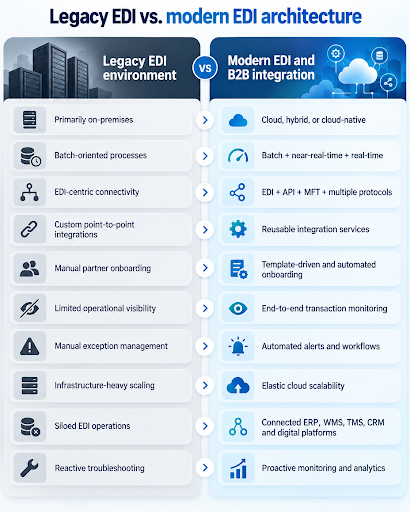
The objective behind EDI modernization is therefore, not to replace one technology with another but to create an integration architecture capable of choosing the right connectivity model for each business process and trading partner. In a nutshell, modernization changes EDI from an isolated transaction engine into part of a broader enterprise integration strategy.
So, where do APIs fit into EDI modernization?
APIs and EDI solve different integration problems. Think of EDI as highly structured business-document exchange and APIs as programmable access to data and capabilities.
For example, an organization might continue receiving a purchase order through EDI while using APIs to provide:
- Real-time order status
- Inventory availability
- Shipment tracking
- Pricing information
- Product information
- Customer portal updates
- Payment status
- Exception notifications
The two technologies can complement each other.
EDI works particularly well when:
- Trading partners already require X12 or EDIFACT
- Transaction volumes are high
- Document structures are standardized
- Established B2B workflows are working reliably
- Industry ecosystems already depend on EDI
APIs become valuable when:
- Information must be accessed in real time
- Applications require synchronous interaction
- Customer or supplier portals need live data
- Mobile or digital experiences need backend connectivity
- New applications need reusable integration services
The modern architecture, therefore, becomes EDI + API, rather than EDI versus API.
A practical roadmap for moving from legacy EDI to cloud & API-based integration
EDI modernization should rarely begin with a large-scale replacement project. A phased approach can reduce operational risk while allowing the organization to capture value progressively.
Step 1: Assess the current EDI estate
Before deciding what should move, understand what already exists. Organizations often discover hundreds or even thousands of integrations accumulated over years. Some are business-critical while some are redundant. Some support partners that are no longer active.
Modernization starts by separating the three.
Step 2: Classify integrations by business criticality
Not every connection needs the same migration strategy. A useful classification might include:
- Tier 1: Mission-critical integrations
High-volume customers, suppliers, carriers, and transactions that directly affect revenue or operations. - Tier 2: Important but lower-risk integrations
Regular trading relationships where limited downtime can be tolerated. - Tier 3: Low-volume or legacy integrations
Connections that may be suitable for consolidation, redesign, or retirement.
This helps leadership teams prioritize modernization based on business impact rather than technology alone.
Step 3: Define the target integration architecture
Before migrating individual maps, decide what the future environment should look like. The target architecture may include:
- Cloud-based EDI/B2B integration
- API management
- Integration Platform as a Service (iPaaS)
- Managed File Transfer
- Event-driven integration
- Centralized monitoring
- Automated exception handling
- ERP/WMS/TMS integration
- Identity and access management
- Observability and analytics
That’s because the goal here is not simply to recreate the old environment in the cloud. That would be hosting modernization without architectural modernization. The bigger opportunity is to simplify the integration landscape.
Step 4: Decide what stays EDI and what moves to APIs
One of the most important decisions is determining which interactions genuinely benefit from APIs. A simple rule of thumb is to keep stable, high-volume document exchange on EDI where it makes business sense. Introduce APIs where speed, interactivity, or reusable access to information creates measurable value. Take a look at some instances below.
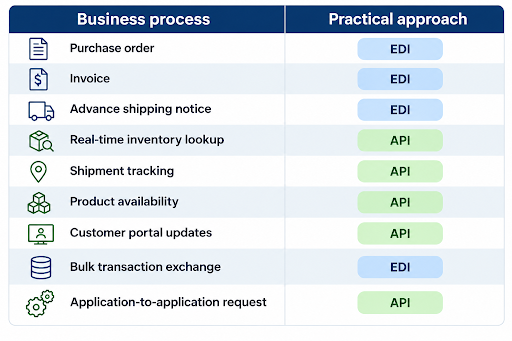
Over time, this creates a flexible hybrid architecture without forcing trading partners to change unnecessarily.
Step 5: Move EDI capabilities to a cloud-based integration layer
Cloud-based EDI platforms can reduce the infrastructure burden associated with traditional on-premises environments. Instead of maintaining servers, middleware, patches, storage, and capacity internally, organizations can move toward architectures that provide:
- Elastic scalability
- Centralized partner management
- High availability
- Easier disaster recovery
- Faster deployment
- Multi-protocol connectivity
- Cloud application integration
- Centralized monitoring
- Usage-based scaling
However, moving to the cloud should not mean surrendering governance. Security policies, encryption, access controls, data residency, backup strategies, SLAs, and disaster-recovery requirements must remain part of the migration design.
Step 6: Modernize trading-partner onboarding
Partner onboarding is one of the strongest business cases for EDI modernization. Traditional onboarding may involve repeated exchanges of mapping specifications, connectivity details, certificates, test transactions, etc.
Much of this can be standardized.
Modern platforms can use reusable templates, automated testing, predefined maps, partner profiles, workflow automation, and self-service capabilities to accelerate onboarding. This matters particularly for organizations with growing supplier or customer ecosystems.
Step 7: Build end-to-end transaction visibility
One of the biggest shortcomings of older EDI environments is that integration teams can see technical messages, while business teams see business processes. Both these worlds need to connect.
A modern integration platform should make it possible to answer questions such as:
- Did the customer’s PO arrive?
- Was it successfully processed?
- Did the ERP accept it?
- Where exactly did a failed transaction stop?
This requires visibility beyond individual middleware components. Operations teams should be able to trace a transaction from trading partner to integration layer to enterprise application and back.
Step 8: Automate monitoring and exception management
Legacy integration teams often spend significant time watching queues, investigating failures, restarting processes, and manually informing stakeholders. Modern platforms can change that operational model. Automation can help detect failed transactions, categorize common exceptions, trigger alerts, retry recoverable failures, route incidents to appropriate teams, track SLA breaches, etc.
Increasingly, AI can add another layer by helping teams identify patterns, summarize exceptions, support root-cause investigation, and prioritize incidents.
The objective is simple:
Move EDI operations from reactive firefighting to proactive management.
Step 9: Migrate in waves
One of the largest risks in EDI transformation is attempting to move everything simultaneously.
A safer pattern is:
Assess → Pilot → Validate → Migrate → Parallel Run → Cut Over → Optimize
For high-risk environments, parallel processing can be used temporarily to compare legacy and modern platforms before final cutover.
ESSPL has previously supported a large EDI migration for a 3PL organization involving more than 1,600 maps across 400+ trading partners. The migration was completed with zero reported defects and delivered a 25% cost reduction. Get in touch with our experts to see if EDI migration within your organization can generate similar results.
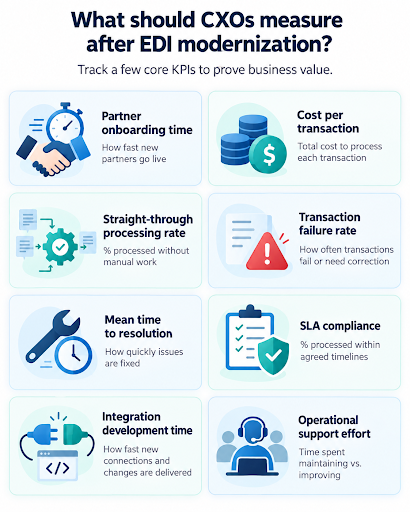
What should CXOs measure after EDI modernization?
How ESSPL can support your EDI modernization journey
EDI modernization involves far more than migrating maps from one platform to another. It requires understanding trading partners, business processes, protocols, enterprise applications, data transformations, SLAs, security requirements, APIs, and operational support as one interconnected environment.
ESSPL brings more than 28 years of technology experience and provides EDI and B2B integration capabilities spanning consulting, trading-partner setup, map development, migration, API-led connectivity, integration support, and managed services. Its published EDI capabilities include technologies such as Oracle SOA, Boomi, IBM Gentran, BizTalk, MuleSoft, and OpenText, alongside ANSI X12, EDIFACT, XML, and related integration formats.
Talk to our EDI & B2B Integration experts to explore the right cloud, API, and migration strategy for your enterprise.

